
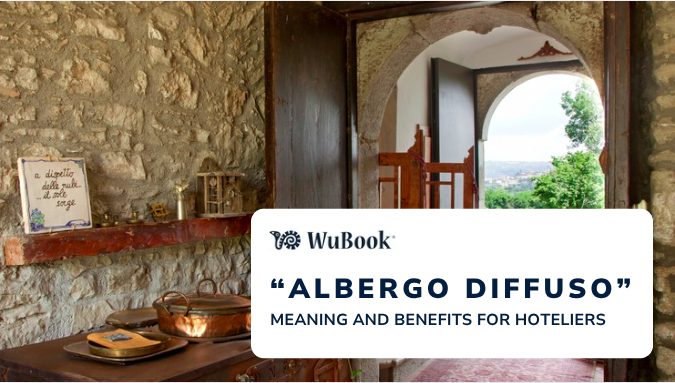
Dear WuBookers, among the most innovative and promising hospitality models is undoubtedly the “albergo diffuso”. A typically Italian property type – though it has already been adopted abroad – that combines the benefits of a vacation home with those of a hotel in a virtuous and effective hybrid model, benefiting both owners and guests. Here’s what it’s all about and how it can be replicated elsewhere.
“Albergo diffuso”: What It Is and How It Works
The term “albergo diffuso” was coined by Giancarlo Dall’Ara, a professor of tourism marketing and consultant for various Italian institutions, who developed the theoretical model for it. It is an alternative to the traditional hotel, though it retains some of its characteristics. The “albergo diffuso,” in fact, is a form of “horizontal” hospitality that isn’t concentrated in a single building (the classic vertical “high-rise” divided into rooms), but is spread across multiple buildings within the same town. The accommodations can be of various types, seamlessly integrated into the urban setting, located close to one another, and no more than 200–300 meters from the main building. This is where the reception desk, dining area, and lobby are located—shared by all guests. In this sense, therefore, the property may resemble a collection of vacation homes, yet it retains certain typical features of a hotel, such as the nature of the services offered and centralized management. Furthermore, compared to other solutions, it offers specific qualities with large-scale advantages.
Typical Features of the “albergo diffuso”
Neither a traditional hotel nor a vacation home in the conventional sense, the “albergo diffuso” combines the best aspects of both and blends them with some unique characteristics: let’s examine them in detail.
Proximity and Context
The first distinctive aspect, aside from its unique scattered layout, concerns the locations where “albergo diffuso” properties are typically found: towns and cities with historical, artistic, architectural, or natural value, often far from the most popular tourist destinations. Small ancient villages, mountain towns, and intimate, little-known towns are all ideal locations for these properties, which cater to the ever-growing interest in sustainable travel and attract guests seeking unique experiences.
Authenticity of the Experience
Those who choose this option want to immerse themselves in the real life of the village where they’re staying: they want to connect with its rhythms and the people who live there, to truly become part of the community rather than simply “consume” it. The “albergo diffuso” guarantees this opportunity precisely because the rooms are not located in a single place but are distributed—each a short distance from the others—throughout the town center, within traditional buildings. The accommodations thus blend seamlessly with those of the residents, and the guest experience is far richer and more authentic than a typical hotel stay.

Varied Regulations
The first “albergo diffuso” initiative dates back to 1998, when the Region of Sardinia (Italy) recognized the first model of this kind. Since then, these properties have proliferated—not only in Italy, where the geographical and social landscape favors this model of hospitality, but elsewhere as well. Today, there are “albergo diffuso” properties even outside of Italy. One aspect to consider, however, for those wishing to explore this form of hospitality is that regulations vary from region to region (and from country to country), so it is important to inquire about requirements, permits, and any available incentives directly with local authorities.
The Benefits of the “Albergo Diffuso”
The “albergo diffuso” offers numerous benefits for its operators, guests, and the entire community where it is located.
For the hotel operator, it ensures:
- centralized management, not unlike that of multiple vacation homes, but with the advantage of the various accommodations being close together, which allows for the optimization of time and tasks (from housekeeping to food service, and so on);
- the potential for seasonality reduction: those who book this type of accommodation do not necessarily travel during peak periods, precisely because they are seeking something different from a typical vacation. This means that even the off-season months could prove profitable for those who own or manage a “spread-out hotel”;
- alignment with industry trends: sustainability is increasingly a key factor for travelers, and for some time now, alongside traditional models, new approaches have been emerging that prioritize greater awareness and respect for the environment and people—such as regenerative tourism. The “albergo diffuso,” especially when located in remote and off-the-beaten-path destinations, can successfully capture and meet this demand;
- the revitalization of abandoned or neglected properties: in general, a “spread-out hotel” offers the opportunity to generate income from spaces that are underutilized or unused, even if they are located in a building separate from the one where the main hotel operations take place (such as meal service or check-in). But be careful: abandoned villages are not the right place to open this type of business, because travelers seek contact with people and their way of life—not complete isolation!
Guests , for their part, can enjoy a truly well-rounded experience, where the typical comforts of a hotel are combined with the added value of authenticity, far from the crowds of tourists. The “albergo diffuso” creates the right conditions for getting to know the locals and their way of life, thereby fostering unique and meaningful moments and memories that last beyond the trip.

Finally, as for the communities of residents, “albergo diffuso” properties generate revenue that benefits the entire area: more visitors also mean greater job opportunities for existing businesses (bars, restaurants, tourist sites, etc.) and employment for local residents (hotel staff, housekeeping, maintenance, concierges, and guides, etc.). Local producers can also find valuable support for their businesses through collaborations and partnerships with the property; meanwhile, the demand for services—cultural events, excursions, visits to points of interest, and more—enriches and revitalizes the local offerings.
All of this is achieved without the “albergo diffuso” interfering with the existing urban fabric or disrupting its aesthetics, since there is no need to construct new buildings; instead, existing structures are utilized, often specifically restored or repurposed.
Useful Tools and Tips for Managing an “Albergo Diffuso”
Although the model is well-defined and recognized, there is no single formula that works for everyone. Once you understand the concept of a “spread-out hotel,” it is important to tailor the methods and operations to each specific case. That said, there are certain best practices that apply across the board to all similar establishments.
Technology at the Service of the Guest Experience
Technology in the hospitality industry is a key ally for making work processes smoother and more precise, thereby improving the guest experience. For a property like a “diffused hotel,” where the guest experience is at the very heart of the operation, this is even more true. Therefore, tools like the PMS are essential for simplifying management without compromising the essence of the stay. An example?
Thanks to Zak, the property management software by WuBook, it’s possible to centralize the coordination of multiple properties on a single platform, viewing all availability and reservations in a single planner, without the risk of overlaps or errors. Not only that, but thanks to the integrated Channel Manager, you can synchronize and manage all major distribution channels—such as OTAs and metasearch engines—to further boost visibility and drive sales. Communications with guests can be automated, relieving the front desk of repetitive tasks while ensuring constant support for travelers. Reporting and analysis of the property’s performance, on the other hand, allow you to keep everything under control at all times to identify areas for improvement and potential growth opportunities. This applies whether the properties belong to a single owner or are multiple properties managed as a single entity (a scenario that aligns the practical needs of those managing a multi-property hotel with those of actualproperty managers).
The goal of the PMS by WuBook is to enable hoteliers to manage a geographically dispersed business in a consistent and uniform manner, which also benefits guests.
The Importance of Communication
Directions to the property, information about the city center and its attractions, check-in procedures, and tips for the stay are always appreciated.
But in the case of distributed hotels, these become essential—much more so than in a traditional property. There are several reasons for this: rooms may be located in places that aren’t immediately easy to find, especially in the absence of signs or other obvious indicators, so it’s necessary to help guests find their way to avoid frustration and dissatisfaction. Furthermore, travelers on this type of trip seek authenticity, and receiving recommendations on local spots or traditions is certainly appreciated.
That’s why automating communications can make a huge difference in welcoming tourists and making a good first impression right away, while meeting their expectations.
Online Accommodation Distribution
Since accommodations can vary greatly in their features, it’s essential to present them in the best possible light and keep descriptions, availability, and rates consistently aligned across all sales channels. This requires constantly updating all distribution platforms. These updates can be done manually – at the hotelier’s own risk, exposing them to the possibility of unwanted overbookings – or through specialized software, such as WuBook’s Channel Manager. While OTAs are often essential to an effective marketing and sales strategy, managing them properly is equally crucial to avoid errors and difficulties that are hard to rectify.
Looking to the Future, Starting Today
Many “hotels diffusi” start with just a few units and grow over time, both in terms of reservations and the number of rooms. This is a common and prudent approach to development, allowing for careful management of investments and operations.
Using tools that support this desirable evolution from the very beginning is not only optimal for current operations (who doesn’t like to work efficiently?), but also avoids future migrations and reorganizations, which result in costs and adjustment times that aren’t always easy to absorb. In this sense as well, technology can effectively support operations and prevent unpleasant surprises today and tomorrow.
Other Recognized Models
The “albergo diffuso” is not the only horizontal model conceived by the ADI, the Italian Association of Albergo Diffuso. Alongside this, in fact, the organization also recognizes:
- the “paese albergo”, which encompasses not only accommodations but a whole range of related services and common spaces for guests. Reservations remain centralized, but management is divided among multiple owners of the individual businesses, who thus create a “hospitality network”;
- the “diffused residence”: non-hotel accommodations offering lodging in various residential units combined with basic hospitality and assistance services managed through a centralized reservation system;
- the rural “albergo diffuso”: a “diffused hotel” in every sense, though located not within a village but in a rural setting.
Although inherently tied to a specific region of origin, this form of hospitality lends itself to being applied elsewhere as well and offers numerous advantages.