
Dear WuBookers, for a few weeks now, OpenAI’s feature allowing users to promote paid products and services within ChatGPT has also been available in Europe. This is an important development that directly impacts hoteliers: tourism is, in fact, one of the sectors most affected by technological and digital innovations, and this case is no exception. Let’s explore the opportunities and limitations of advertising on ChatGPT and how the Ads Manager works, based on the latest guidelines released by the platform.
What Are ChatGPT Ads and Who Can See Them?
Since February of this year, OpenAI, the company that owns ChatGPT, has introduced a sponsorship system within its virtual assistant. The pilot program began in the U.S. and is gradually rolling out to the rest of the world. As of this article’s publication, this feature is already available in several European countries, including France, Italy, Spain, Germany, Denmark, Poland, Ireland, and the United Kingdom, but the official list is constantly being updated.
Through OpenAI’s Ads Manager dashboard, it is therefore possible to create paid campaigns to promote products or services within user-generated chats. This means that when a person asks ChatGPT a question, the responses may include both organic information gathered independently by the chatbot and advertisements funded by individuals and professionals interested in appearing among the results.
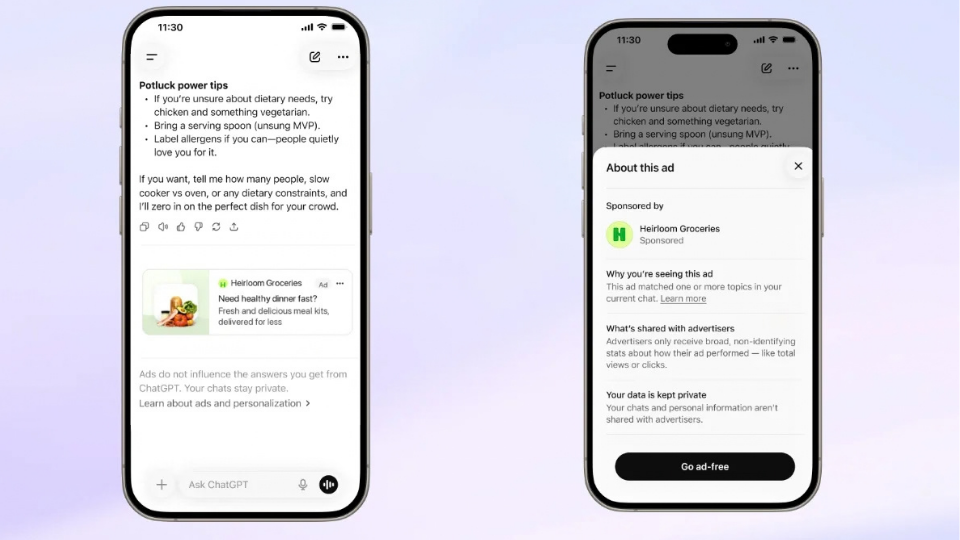
The company clarifies that the ads are labeled and therefore visually recognizable as such. Furthermore, they do not influence the information provided by the AI and are shown only to users over the age of 18 who use a free account.
How Ads Are Structured and When They Appear
Just as is already the case with Google Ads and Meta Ads, an ad campaign can contain multiple ad groups. These, in turn, include various elements: the name of the advertiser, its logo, the ad’s headline and text, the image, and the landing page. People who click on the ad are then directed away from the chat environment to an external site, which, in the case of hotels, could be, for example, the hotel’s homepage or the reservation page.
Sponsored content on ChatGPT is displayed based on a series of criteria, such as relevance to the context and conversation, suggestions provided by advertisers during campaign creation (e.g., topic and keywords), and user preferences, if enabled.
Costs vary, and the payment model is twofold: you can choose to pay per impression, thereby focusing on ad reach or visibility; or per click, placing greater emphasis on traffic.
What opportunities are there for hotels?
The tourism industry has always been open to change, and in recent years, artificial intelligence has transformed the way people travel, and beyond.
More and more people (over half of Americans, according to recent estimates) are turning to tools like ChatGPT to plan their vacations. What they get isn’t just simple guidance, but fully curated itineraries with destinations, attractions to see, things to do, restaurants, and accommodations already organized based on personal parameters, such as price range or style. Whereas a Google search results page offers people a variety of results to evaluate and browse through, a chatbot instead provides a complete proposal tailored to the user’s preferences. The selection and decision-making process is greatly streamlined, and the gap between search and reservation is narrowed.
The potential for those in the hospitality industry is therefore clear: a customer journey structured and streamlined in this way guides the choice and reduces the chance of distraction because everything takes place within the chat interface, which can only be exited during the actual purchase phase. This means that an ad appearing at the right moment and within the right conversation can be decisive in quickly converting simple exploration into a sale. A well-designed campaign could thus lead to more direct reservations and, in the long run, to less reliance on OTAs and other intermediaries.

Differences Compared to Google and Meta Ads
Google Ads and Meta Ads, as well as the Google My Business listing, are also designed to generate more direct reservations: so what’s different about advertising on ChatGPT? We’ve already touched on this briefly: the main difference lies in the browsing experience the user has when they see the ad.
Ads that appear on Facebook and Instagram, for example, are targeted but not tied to a conscious search: they interrupt the flow of content, trying to capture the user’s interest while they’re scrolling. Google, on the other hand, responds to a voluntary query but displays ads from many businesses competing for the same keyword, running the risk of diluting the user’s attention.
ChatGPT Ads, however, operate within a framework that first requires user input (or rather, a prompt), a specific intention, and contextualizes the response within a personalized and circumscribed situation. It’s the first step in that famous “tailored journey” that many guests seek, and one that can begin well before they even set out.

What to Do Now That ChatGPT Ads Are a Reality
As we know, however, a single ad is unlikely to generate enough revenue to get the property off the ground. In other words: for advertising to work, you need an effective marketing and communication strategy, which cannot rely solely on online advertising. In addition to exploring and testing the new opportunities offered by ChatGPT (and doing so immediately could provide a significant competitive advantage over the competition), it is therefore important that hoteliers and property managers continue to:
- carefully curate every detail of their property’s image. The website must be up to date; room and amenity descriptions must be accurate and detailed, accompanied by high-quality photos and videos; and the reservation system must be efficient and user-friendly;
- ensure that all active channels (social media, OTAs, etc.) are consistent with the brand image: outdated photos and information risk driving people away and sending conflicting signals to chatbot scanning systems, which could then penalize your hotel’s organic and paid visibility;
- continue to produce content and request reviews: these are positive signals for both potential guests and artificial intelligence, which places particular weight on the most recent comments.
Overall, ChatGPT ads certainly open new doors for hotels and properties in general, but this strategy must always be carefully considered and integrated into a broader, more comprehensive plan, without losing sight of the quality of the content and the offering.