
Dear WuBookers, in recent years, Artificial Intelligence has become an integral part of many aspects of our lives: at work and in our free time, we increasingly use tools developed or integrated with AI. This also applies to tourism, where chatbots and virtual assistants are now an established reality. But it also affects the way travelers search online. So, how can you get found by those who use artificial intelligence to search for accommodation?
AI and travel: how travelers’ habits are changing
This is not the first time we have talked about AI and the tourism sector, but while we previously focused on how “intelligent” tools can help with hotel management, today we want to analyze another aspect of the issue: user searches.
According to Statista, 4 out of 10 people worldwide use tools such as ChatGPT, Perplexity, and Gemini to organize their trips: a percentage that varies from country to country, but which reveals a growing trend. This is also confirmed by the recent Global AI Sentiment Report conducted by Booking.com. According to the platform, despite concerns about the possible implications of using AI, 89% of consumers are ready to use it to plan their trips in the future, and almost all of them have already used it at least once. Many also believe that AI recommendations are more reliable than those of friends or industry influencers.
From SEO to GEO: how artificial intelligence systems work
But how does artificial intelligence work? ChatGPT and similar programs are based on a technology known as LLM (Large Language Models) and scan the sources in their database to find the information most relevant to the user’s request. The result is not a simple list of links or information, but a discursive and structured response, as if it were a conversation.
Since March 2025, Google has also adopted a similar system within the SERP (search results page): the AI overview, which (for certain searches) immediately presents a summary of the main content accompanied by links, followed by the classic list of organic and paid sites that we are used to seeing.
In addition to this, there is also AI mode, which allows you to interact directly with Gemini within a separate window.
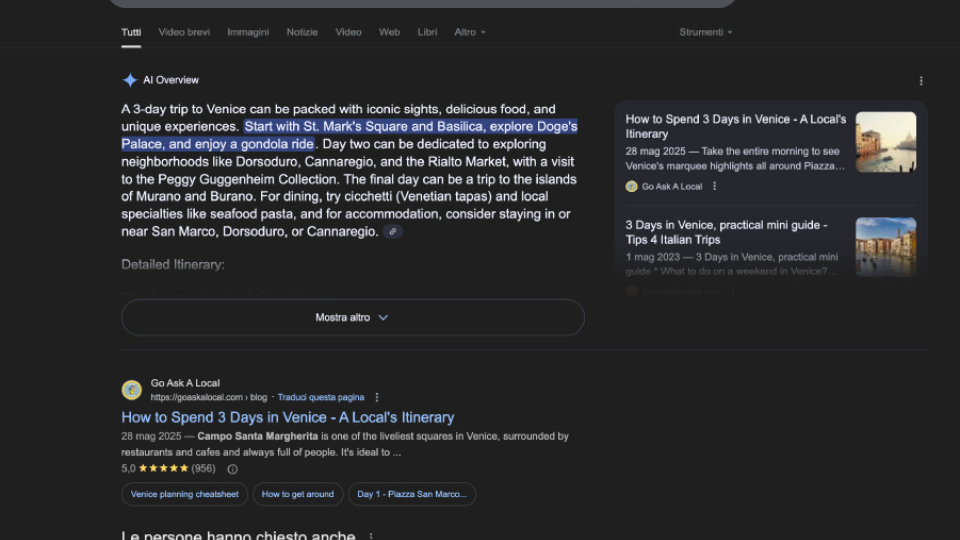
All these changes have led to the emergence of new marketing strategies for appearing in engines that use artificial intelligence: lately, the talk is no longer just about SEO (Search Engine Optimization) but about GEO (Generative Engine Optimization), i.e., best practices recommended for being cited and recommended by AI as an authoritative source.
Authority is one of the fundamental criteria for appearing in the responses of Gemini, ChatGPT, and others, even when it comes to properties, but it is not the only one. Let’s take a look at them together.
How to appear in AI-generated results
SEO for hotels is not an exact science, and the same applies to GEO: there are no hard and fast rules, but there are a number of measures we can take to try to “get into the good graces” of AI.
Take care of your website, starting with the technical aspects
To respond to travelers’ requests, AI refers to what it finds online. This means that if your site is not well-maintained and complete, the chances of it being considered reliable are drastically reduced. A well-designed website is, first and foremost, a website that works: neglecting technical aspects such as SEO optimization, loading speed, and other Google evaluation parameters is a bad start. From this point of view, Zak (the PMS by WuBook for hotels) is ideal, as it allows you to create websites that are high-performing and customizable, already integrated with the reservation system.
Write as you speak: pay attention to content and language
Content must also be organized to maximize navigation: room descriptions, for example, must contain all the information useful to a potential guest, described in natural, simple, and clear language. Don’t be afraid to go into too much detail, as it will be very useful when someone asks the AI very specific questions. Remember that, in addition to the answers, user searches are also changing: no longer just dry text strings (“hotel in the center of Rome”) but real questions (“can you recommend a hotel in the center of Rome with a view of the Pantheon and breakfast in the room?”). That’s why, when describing accommodations, it’s important to include all the elements that characterize them, even those that seem insignificant or trivial.
Always try to anticipate the curiosities of potential guests by including FAQs (frequently asked questions and answers): these should also be formulated in a straightforward and conversational style to help people and AI find what they are looking for quickly.

Be consistent across all channels
Even though it takes only a fraction of a second, before providing an answer, artificial intelligence analyzes many sources together and, based on a series of factors, determines which ones to propose to the user. Among these is the consistency of information: being present on multiple portals is therefore fine, but make sure that the name of the hotel and its contact details are identical everywhere. Room descriptions and images must also be updated on all channels in the same way to avoid confusing those who are looking for you and misleading the technology.
Request and manage reviews
We know that guest feedback can be a real thorn in the side, both when it is absent and when it is negative. However, encouraging and managing reviews in the best possible way also serves the “eyes” of AI. In fact, GPTs also evaluate a hotel’s reputation based on reviews on the website and other sites such as TripAdvisor, Google, and Booking. So, be sure to always ask for feedback from those who have stayed at your property and respond promptly and courteously even to those who do not express a favorable opinion: promptness and kindness are essential to make a good impression on those who do not know you (including AI!).
Create a network of online relationships and mentions
Reputation is important, but so is credibility. In addition to dealing with reviews, it is important to build a network of relationships and valuable links that refer to your site: signals that confirm the seriousness and notoriety of the property, and therefore its reliability. Collaborating with industry websites, influencers, tourism boards, and specialized magazines can be a good way to ensure visibility and traffic from authoritative sources. The content doesn’t have to be long; a few lines and a well-placed link are enough to create a quality network.
These are the main precautions to take in order to appear in AI results and reach an increasingly wider audience of travelers, thus increasing direct reservations. In addition to the response, these tools offer a direct link to the property’s website: being mentioned is not a matter of vanity but of strategy and revenue for the property.