
Dear WuBookers, digitization and dematerialization are trends that have long affected the hotel property industry as well, which is exposed to customers’ growing demand for efficiency and privacy. For this reason, alongside increasingly smart rooms and increasingly automated reservation processes, so-called “keyless hotels” are also gaining ground. Thanks to specialized technological devices (similar to those already in use in many B&Bs, vacation rentals, and non-hotel properties), even the most traditional hotels can adapt to this new reality: let’s see how.
What are keyless hotels and how do they work
“Keyless hotel” literally means a hotel without keys and refers to properties that do not use physical access devices for rooms. This excludes both traditional metal keys and magnetic cards, which are still widely used today. So, how do you get into the room? There are various systems, ranging from simple to advanced, that allow guests to be self-sufficient at all times without having to worry about picking up or returning keys at the front desk during check-in and check-out. In addition to the absence of keys, in fact, these solutions are mostly contactless, meaning they work without any personal interaction with hotel staff. Here are the main ones.
PIN Code
The simplest version is the PIN code system. The guest receives an identification code on their phone (or another device provided by the hotel) and, to enter, simply enters it on the keypad located outside the room. This option is very practical because it is easy, immediate, and intuitive, and doesn’t even require an internet connection.
Hotel App
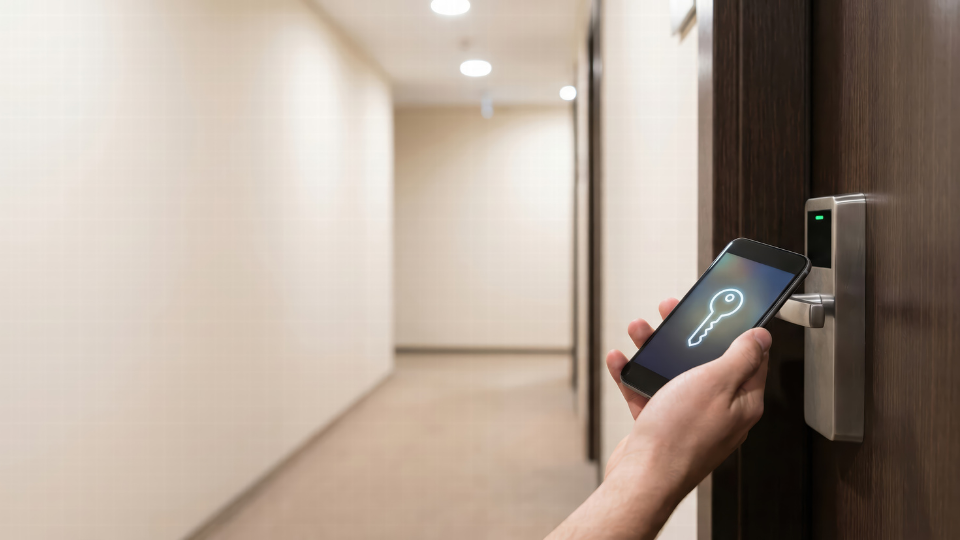
In this case, the guest downloads the hotel app onto their smartphone and receives a digital unlock code when the room is ready. To gain access, all they need is a tap or swipe on their smartphone: the app communicates directly with the lock and the door opens. Alternatively, there are microchips that work the same way but without a linked app: in both cases, however, a Wi-Fi connection is required.
QR Code
Similar to a PIN code but using a QR Code, which is generated and sent to the guest via email or SMS. To open the door, the guest must show the received QR code on their phone to the external scanner to unlock it. Usually, with these devices, an internet connection is optional.
Biometric Systems
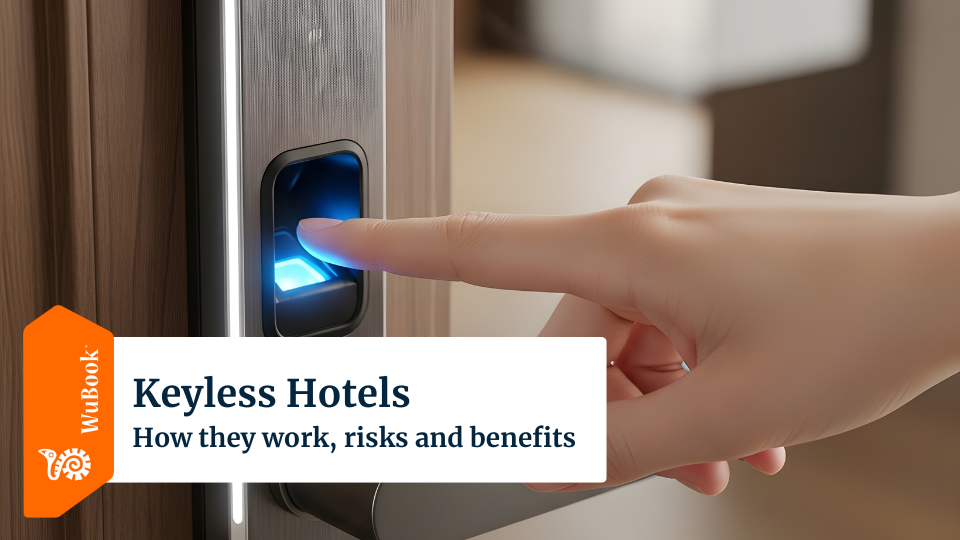
Significantly more advanced, biometric systems have so far been introduced in only a few luxury hotels. Facial or fingerprint recognition is certainly cutting-edge, but it can require rather expensive hardware, especially to ensure guest privacy and data protection.
Voice recognition
Equally in its infancy, but still worth knowing about, is technology based on guest voice recognition. For everything to work, you’ll also need a smart speaker or mobile assistant that can receive the command and open the door.
Advantages and disadvantages of keyless solutions
Diverse and up-to-date, keyless solutions have many positive aspects but also require some considerations that are worth knowing to make an informed choice suited to the needs of your property and clientele.
5 good reasons to become a keyless hotel
Keyless solutions are in line with current trends in technology and industry evolution and offer several advantages, both to guests and hotel staff. For example:
- They eliminate lines and long waits at check-in: imagine how wonderful it would be to offer your guests the option of arriving at the property and going directly to their room without stopping at the front desk. That’s exactly what happens with keyless systems, which ensure a smooth, hassle-free process;
- They allow staff to work more efficiently: saving guests from long waits also means preventing awkward or tense situations that can then fall back on the staff. Dealing with customer dissatisfaction can cause stress and wear down staff, lowering the quality of service. Additionally, these systems can remain operational even at night in place of reception staff;
- They enhance security and reduce costs: forget about the problem of lost or duplicated keys. With keyless solutions, security is enhanced (codes are one-time use and can be regenerated in no time), partly because there are no physical devices that can be lost or copied, and consequently, there are no associated costs for printing new cards;
- Track guest access even remotely: the issue of security might, however, raise some concerns among hoteliers. Well, the systems operate remotely, tracking all guest access: this way, it’s always possible to verify entry and exit movements and intervene if necessary;
- Ensure greater privacy: more and more customers say they appreciate technological solutions that avoid human contact. This is guaranteed within keyless hotels because, as we mentioned, all the methods described are also contactless and protect customer privacy;
Potential downsides and considerations
Like all innovations, keyless solutions may require some adjustments, primarily for the hotel, which must adapt to the new technology and implement the new systems, both practically and operationally. In addition to structural changes, staff training must be considered; however, staff roles are not entirely eliminated: it is still necessary to provide assistance in case of temporary issues or human support for guests who encounter difficulties.
The environmental and economic aspects remain somewhere between pros and cons. It is true that eliminating plastic cards means reducing the amount of waste from this material; on the other hand, however, the technology itself consumes energy and natural resources to function.
From an economic standpoint, however, it is possible that, by eliminating human contact, we may also miss out on upselling and cross-selling opportunities, especially if these are not compensated for by other channels and strategies, such as email marketing, for example.
What to Consider When Choosing a Digital Solution
Setting aside general pros and cons, to determine which solution is truly right for us, it is helpful to consider some very practical factors.
1. Integration with the management software
Keyless technology should communicate seamlessly with the PMS, the hotel management system, to make the entire process truly efficient without interfering with internal operations. Before purchasing a contactless system, therefore, be sure to verify its possible applications and how it integrates with your property management software.
2. Up-to-date data protection measures
While it is true that these systems enhance the property’s security, it is also true that, since they use customer data and contact information, they must in turn comply with the online security standards in effect in the country where they are used. For this reason, it is important to ensure that data protection protocols are valid and up-to-date.
3. Ease of use
Finally, don’t forget that you and your staff will be the ones using it. It is therefore important to schedule a dedicated training session with the provider and verify that the system is easy and intuitive to use. The last thing you want is to streamline check-in procedures for guests while increasing your staff’s workload!

Zak from WuBook and Rivola: Keyless Hotel Apps Seeking the Best
What if we told you that, precisely to address all these needs, we’ve collaborated on creating an app dedicated to self-check-in with a keyless system? Thus, from the collaboration of our respective technical teams,Rivola App was born, the hotel app that integrates seamlessly with Zak, the PMS by WuBook, and streamlines all check-in and room access operations.
Before arriving at the hotel, guests receive a reservation ID code that they simply enter into the monitor at the property. There, after completing remote facial recognition (face matching) in just a few steps, they receive a second code used to unlock the room’s electronic lock or the key box containing the keys. This way, the hotelier can be sure to welcome the expected guests: the liveness detection and anti-spoofing systems provide complete peace of mind for managers because they ensure that the guest is physically present in front of the camera or sensor and that there is no attempt at fraud via video, masks, or other methods.
Not only that, but users of the web version of the Rivola App can also rely on the guest’s mobile phone geolocation: this way, the host can be certain the guest is actually present at the property, eliminating the risk of fraudulent check-ins by third parties.
On the other hand, travelers are self-sufficient and guided step by step through the room access procedure, while hotel staff can focus on other tasks.
In fact, among the advantages of the Rivola App is its seamless integration with the physical front desk. In other words, the hotelier can decide whether to activate only the app, and when, or to give the guest the freedom to choose between the physical desk or virtual check-in. And, of course, it works in many languages.
It’s true, keyless solutions can raise some concerns, but once you find the right one for you, you won’t want to go back.