
Dear WuBookers, if you are wondering about the most effective strategy for promoting your property or if you are planning the actions to be implemented in the coming months, it may be the right time to consider influencer marketing. Or rather, micro-influencer marketing for your hotel. Micro-influencers can bring great results: it’s all about knowing how to choose them and defining expectations and objectives clearly from the outset. But let’s take it one step at a time.
Who are micro-influencers
The world of influencers (people who create content on social media that can influence those who view it) is divided into different categories depending on the number of followers they attract. The boundaries between the various types are somewhat blurred, but we can say that micro-influencers have a community of between 50,000 and 100,000 followers: more than nano-influencers but less than social media stars with much larger fan bases.
Despite the seemingly reductive label, we are talking about interesting numbers, especially for small businesses that struggle to reach such a large audience organically, i.e., without resorting to paid social advertising.
This particular type of digital content creator can prove invaluable for hotels and other properties in general: in most cases, micro-influencers can count on a loyal and active audience that trusts their advice and is ready to follow them.
The mechanism by which this happens is very similar to that of online reviews: we are often influenced by what we read, even if it is written by a complete stranger. The advantage of influencers is that, through photos, videos, and frequent content, the stranger no longer seems like a stranger, and if we share their tastes or like what they have to say, we are inclined to do what they suggest.

What can micro-influencers do for a hotel?
Another interesting aspect of micro-influencers is that, in most cases, they have a niche audience. Unlike more famous personalities, who span various sectors, micro-influencers tend to have their own area of expertise and specialize in that and related topics. For example, there are creators who focus on travel (travel influencers), food (food influencers), beauty, luxury, and so on.
This means that the same property could be promoted by multiple influencers who approach it from different angles.
Travel experts are certainly an important group to consider: these are people who, for a living, try out and promote destinations and accommodations, showcasing them in their social media content. But a hotel could also target other micro-influencers. Does the in-house restaurant offer a special menu or one curated by a famous chef? Is the spa and wellness program one of the strong points? Is sustainability a key concept or, perhaps, are there activities or programs designed for children? All of this can become promotional material through different influencers who are close to that particular theme or audience segment.
What does the collaboration consist of?
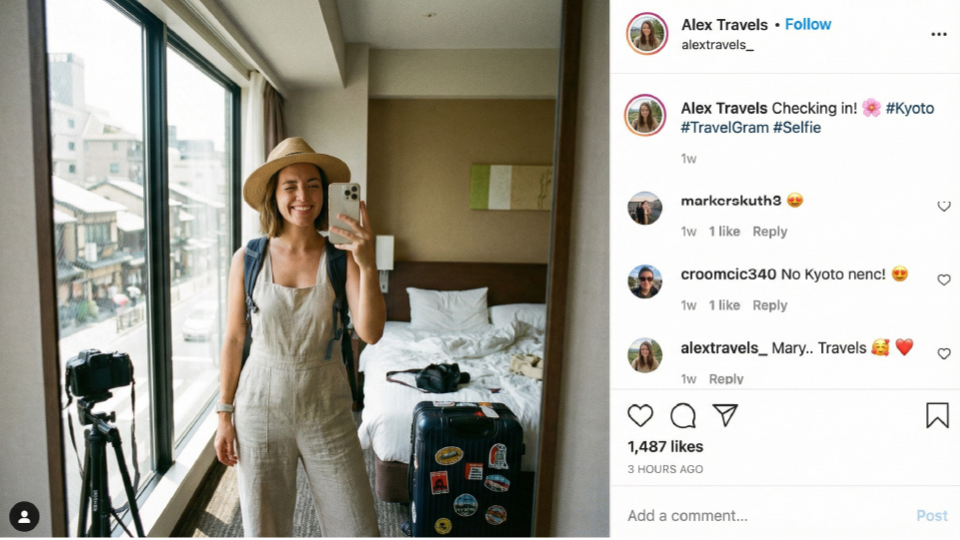
Usually, the agreements, which must be defined in an ad-hoc contract that protects both parties, provide for a free stay for the influencer at the property with free access to the facilities and a payment for the creation of content. The content produced (detailed by quantity, channels, and type, e.g., posts, stories, reels, long form, and so on) is then published on the influencer’s profiles or profile and, if agreed, can be reposted on the hotel’s channels.
This allows the hotel to showcase itself to a community of new people and thus attract potential customers.
How much does a micro-influencer cost?
That’s the million-dollar question! The answer, as you might expect, is: it depends. It depends on the sector and the following of each individual influencer, but also on the engagement rate and the number of platforms and content agreed upon. Needless to say, micro and nano influencers tend to cost less than their more established counterparts.
To get a rough idea, we refer to the Influencer Marketing Hub’s State of Influencer Marketing report, which provides a general overview of costs per channel. On Instagram, for example, “even mid-tier influencers can earn up to $5,000 per post, although actual rates may vary based on follower count and content quality.”
These investments can weigh differently for each property but, in general, require careful planning.
How to choose the right micro-influencer for your hotel: 3 mistakes to avoid
But how do you choose the right micro-influencer for you? It’s not a simple task. It is no coincidence that there are specialized agencies that can take care of the scouting phase and the relationship with creators during the working relationship.
In any case, whether you decide to proceed independently or with the support of a structured organization, it is essential to try to avoid these 3 mistakes.
1. Not considering the target audience
Choosing a micro-influencer just because we like them or think they are capable is not the best idea. It is important to consider the target audiences: both ours and those of the creator. Ours, because if the hotel’s guests are, for example, mainly foreigners or business customers, they may not be interested in social media at all.
For the same reason, it is necessary to evaluate the micro-influencer’s audience if you do not want to risk talking to people who have little or no interest in the service.
Credibility is an essential aspect in making the operation truly effective: that is why it is good to focus on people who share our values or are in line with our philosophy and offering.
2. Ignoring objectives
Another very common mistake is not defining specific objectives before starting to collaborate. Of course, the quality of the content is important, as is visibility tout-court, but the entire operation can and must be analyzed using objective parameters, such as engagement rate, views, comments, and even reservations.
One way to monitor the latter – which is not always visible from tracking tools – is to provide the influencer with a discount code and count how many reservations use it to determine the success, or failure, of the activity.
3. Not having the channels or property ready
Everything is ready: agreements have been made and creators are on their way, but… your social media accounts have been abandoned for months or you don’t know how to manage the reservations that may come in as a result of the promotion! Unfortunately, this means wasting money and opportunities. When everything goes as it should, influencer marketing exposes the hotel, B&B, or similar property to considerable online traffic: people search for the property on social media and online according to a customer journey that starts with a post but then unfolds in many other steps. Being prepared helps to reassure users about the real quality of the service – we were talking about credibility a moment ago, remember? – and offer possible conversion points (a request for information, a call, a direct reservation).
On the contrary, there is a real risk of nullifying all efforts and even generating counterproductive visibility.
In summary, micro-influencers are communication professionals who can be very useful in increasing the hotel’s reputation and revenue, but – as with everything, especially those that come at a cost – planning and strategy are excellent travel companions!