

Dear WuBookers, hotel rates are an integral part of your sales strategy and allow you to maximize revenue from every room. That’s why it’s essential to understand not only the technical jargon but, above all, the substance behind certain technical terms. In this article, we’ll focus specifically on the rack rate, a very important rate type for managing your entire pricing structure and presenting your hotel convincingly to potential guests.
What Is the Rack Rate
The rack rate is the highest rate available to guests, without discounts or promotions. This excludes special offers, group rates, or bulk sales (such as those made to so-called bed banks). The rack rate is set by the hotelier and is made public, so it is visible to travelers.
It is often confused, and sometimes does in fact coincide, with the so-called BAR (Best Available Rate), which, however, represents the best rate available for a room at a given time, not the maximum price guests might pay.
Setting the rack rate serves as the basis for creating special offers and ad hoc discounts that lower the price and increase the perception of value in the eyes of prospective customers.

How It Is Calculated and What Influences It
The rack rate depends on several factors and, for this reason, varies from property to property and from period to period.
Factors that influence this rate include:
- the hotel’s operating expenses, including fixed and recurring costs such as maintenance, cleaning, utilities, staff salaries, insurance, services, and everything else related to the property and its management;
- market conditions, namely actual demand, with all its fluctuations, and competitors’ offerings, a necessary aspect for ensuring the property’s competitiveness;
- the time of year, to ensure profits consistent with high season (when the rack rate can be slightly higher) and low season (when it’s advisable to lower it to encourage reservations);
- the target audience: spending power varies depending on the type of tourist, so it’s essential to set rates that are within the budget of the guests we want to attract;
- the property’s positioning is equally important and has a direct impact on brand communication: luxury hotels can aim for higher rack rates, while more modest hotels settle for lower rates.
In addition to these factors, there are considerations and objectives closely tied to revenue, such as the target ADR, that is, the average daily rate (Average Daily Rate) we aim to achieve.
There is no universal formula, but it can generally be calculated by taking into account the costs per room + (cost per room × desired profit margin).
Room costs are calculated by adding up all annual operating expenses and dividing the total by the number of available room nights in a year. Let’s look at an example.
A hotel has 35 rooms and total annual costs of 730,000 euros. There are 12,775 available nights (35 rooms × 365 days), so the cost per night is approximately 57 euros (730,000 euros ÷ 12,775). If we consider a target profit margin of 25%, the rack rate would be: 57 euros + (57 euros × 0.25) = 71.25 euros per night.
With this calculation, it is possible to determine a starting point to be further refined based on the factors indicated above, it might be too high or too low, and the target ADR.

How to Manage the Rack Rate
The rack rate is therefore the maximum rate, the full price, from which discounted rates and promotions are derived. And since the factors that determine it change from day to day, the rack rate must also be updated accordingly. In other words, it’s not enough to set it once and for all; it must be modified and adjusted to market conditions, based on fluctuations in demand, competitor benchmarks, and so on. This strategy, known as dynamic pricing, can be implemented in two ways: using an advanced Revenue Management System (RMS), which automatically adjusts rates for you; or manually, with the support of specialized hotel management technology (PMS, Property Management System).
In the first case, you’ll enjoy the convenience of software “that runs on its own,” but precisely for this reason, it’s quite sophisticated and requires a solid understanding of revenue management. Updating via a PMS, on the other hand, has fewer features but is accessible to everyone and allows you to set precise rules to manage rates in an automated yet controlled manner.
Zak for managing the rack rate (and all other rates!)
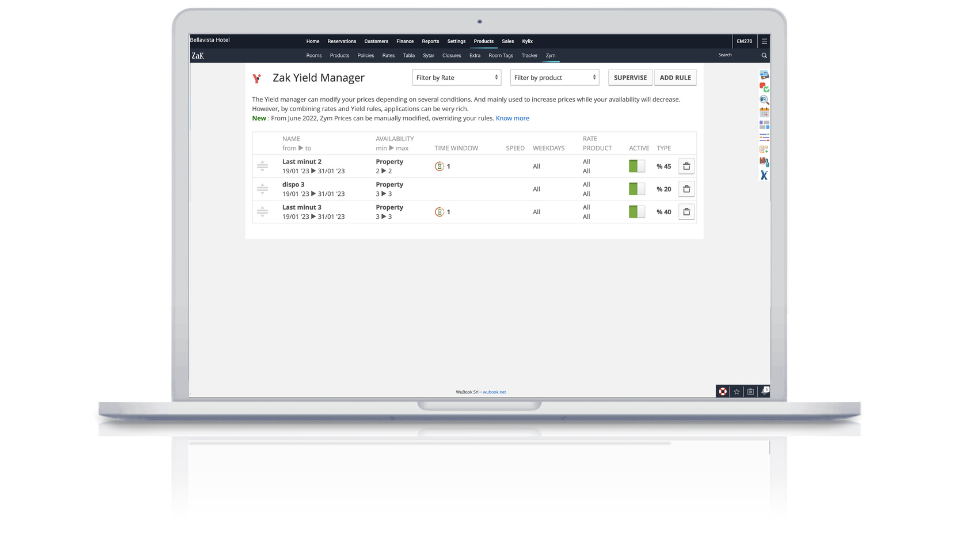
Zak, the PMS for properties by WuBook, offers exactly that: operational simplicity and technological precision. With this software, you can create as many rates as you want, including the rack rate, and modify them whenever you see fit. Not only that: you can also set up automatic derivation rules between rates as you see fit, to update prices according to your criteria. For example, you might decide that a certain rate increases or decreases during specific times of the year, or as certain conditions, such as occupancy, change. This allows you to set the parameters by which Zak automatically calculates sales prices and displays them in real time across all connected distribution channels. This way, you’ll no longer have to deal with the hassle of manual interventions or worry about how the software works, you’ll always have everything under control without the effort of having to manage it yourself.
What are the benefits of rack rates?
But, ultimately, what are the benefits of rack rates, and why should a hotelier or a property manager set them?
Optimize Revenue
Rack rates, since we now understand there’s more than one, allow you to fully capitalize on demand spikes and special occasions by charging the highest price the market is willing to accept. Adjusting this rate in a strategic manner therefore boosts revenue and increases the property’s profit margin.
Streamlining the Management of Discounts and Derived Rates
The rack rate provides a reference point for structuring discounts and promotional offers, making the property’s entire pricing system more consistent. This flexibility allows you to offer attractive prices without undermining perceived value. Furthermore, rate consistency translates into a smoother experience for guests and a lower margin for error in day-to-day management.
Promoting transparency
Speaking of guests, openly communicating rack rates also means providing a clear view of pricing, a factor that helps build trust with customers. This choice can make all the difference in a competitive market like hospitality, where building strong guest loyalty is often key.
Strengthening the Brand Image
A carefully set rack rate also helps improve brand perception and can give the property an image of exclusivity and value. “High-end” positioning, when appropriate, can also attract a more selective clientele willing to invest more to enjoy a quality experience.
For all these reasons, the rack rate is an essential tool in pricing strategy, one that should be thoroughly understood and managed with full knowledge of the facts, from theory to practice.